“By using the Gatsby Benchmarks, we now have young people that want to achieve”
Karen Hayward, Executive Principal at Sandy Secondary School in Central Bedfordshire, shares how she has embedded a culture of good careers guidance across her school of 1,200 students and the resulting impact on whole-school performance and student outcomes. Karen Hayward
Karen HaywardExecutive Principal, Greensand Federation
What are your key priorities as the leader of a large secondary school?
In the kind of town that we’re situated in, commercial activity is very much down. There isn’t a lot of ambition. Attendance at school is an issue for some students. They don’t see the point of education and lack motivation and aspiration. We have to work hard to engage learners, to get them to realise that education is the key to opening up the world outside where they’re growing up.
So, preventing students becoming NEET is a big leadership focus for us, in a school of this size. For us, students falling into the NEET category means that we’ve not been successful. It means that they’ve not got a clear progression route or future. That, for us, is a failure.
Tell us about your approach to NEET prevention.
We’ve found that one of the strongest, most effective tools we have to tackle young people becoming NEET is a really strong careers programme, using the Gatsby Benchmarks. It’s essential to giving our young people ambition, to giving them a sense of purpose, but also to giving them a focus on where they want to go to next. It’s a priority right across the school.
For us, careers guidance is about building resilience. It’s about providing students with a clear progression route. It’s about giving them that motivation that comes from bringing the real world into the classroom and taking young people out of the classroom to experience what could be next in the real world.

What impact has making the Gatsby Benchmarks a strategic senior leadership priority had on your school and students?
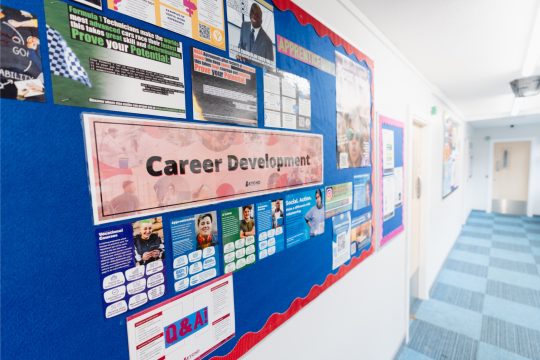
Prioritising careers education, led from the top, has generated improvements across the school and in students’ attitudes. It has led to better attendance – it makes our students want to come to school. It’s led to improved behaviour – students want to learn, are more focused in lessons, and have higher expectations of themselves. And it’s impacting attainment and progression because students see the point and value of education. They can see a future for themselves – they know where their ambitions lie and what careers they can aim for. That’s been the pinnacle for us. By using the Gatsby Benchmarks, we now have young people that want to achieve.
Recognising the link between good careers education and attainment was transformational for us. We began to realise that you can focus a lot on trying to get exam results up, but that ambition and aspiration that you get through careers education has to also be there if you’re going to succeed. That was what was missing for our students – good career guidance was the missing link to raising attainment for us.
We’ve moved from Requires Improvement in our Ofsted inspection to Good in just two years, with the inspectors highlighting our strong commitment to raising outcomes and our thoughtful approach to careers guidance.
Where did you start with the school’s careers guidance improvement journey?
I undertook careers leadership training alongside my careers leader in 2024/25. I felt that I needed to do that to properly support him and to properly bring careers right into the heart of what we do at the school. We’ve used the DfE guidance for careers education, and the Gatsby Benchmarks within that, which are essential in delivering a really high-quality careers programme. By using those, we’ve made careers a priority right the way from the senior leadership team all through the school from Year 7 to Year 13.
For me, improving your careers education programme isn’t about making huge changes or doing lots of different things. One of the best things we did was not running before we could walk and getting support from our Careers Hub. That helped us recognise how we could better focus what was already happening in the school and what different things we needed in play. Much of it is about more strategically planning and evaluating what you already do – mapping across the school, across the year, across your different students.
More from Karen
“I got me to come to school and it made my behaviour a lot better. Now I’m excited to get a good job. And a job that I enjoy.” Karen and student, Kelsey, talk about Kelsey’s careers guidance journey.
Karen and Kelsey join other students and their principals to explain how making careers guidance a senior leadership priority helps keep young people in education, employment and training – watch our short film.